Saturday, 30 May 2015

Fifty shades of Spey (cont.)


My intermittent walking of the Speyside Way continues every time I return home for a family visit. On this occasion, my route weaves in and out of the River Spey’s famous whisky trail.


Walking the old railway line

I also have company, my brother Sean and our stepmum Marion. Much of the trail follows an old railway line, one of the many that was decommissioned in the 1960s. This one connected Grantown-on-Spey with Elgin.


Marion and Sean, on track

As a former rail track, the path is often straight, much of it is tree-lined, and it takes along steep-sided embankments and across iron bridges.


Iron single-track bridge

A rare glimpse of the Spey

We walk past two old stone-built stations, now converted into holiday cottages, though the destination names are still proudly displayed. One, Blacksboat, is named after the ferry that carried people across the Spey in the days before the road bridge was built.


The station for the ferry crossing

At Ballindalloch we hit distillery country, with Glenlivet, Cragganmore, Tormore, Cardhu and Glenfiddich all nearby, then Tamdhu right by the path. We get whiffs of the aroma of fermenting grain long before the pagoda-like sheds and giant vats come into view.


Tamdhu mash tun

We’re now at Knockando, near the end of the day’s walk, and Sean has heard of a nice café in a former woollen mill just up the road. The Knockando Woolmill (knockandowoolmill.org.uk) turns out to be a fascinating – and newly operational – slice of Scottish textile history. 


Tweed bunting outside Knockando café

Back in the 18th century, the mill was a bustling weaving hub for a clientele that stretched across the Highlands. District woollen mills were common as many homes were too small for some of the processes involved. Farmers brought fleeces to be converted into yarn, cloth and blankets. Tweed and other products were also sold. Knockando would have been a working farm, too, as textile production often went hand in hand with agriculture. But mass production in the 20th century saw the mill decline and and production eventually ceased. Now, the original Victorian machinery has been restored so that it’s fully operational, and a variety of designers create dazzling contemporary patterns. Once again the walls echo with the sounds of industrial-scale weaving – indeed two of the looms in the weaving shed are thought to be the oldest still working in Scotland.


Revitalised Victorian loom

In the mill’s shop there is plenty to tempt us, from plaid handbags to mobile-phone carriers. But it’s the mill’s café we’re after, for its freshly made soup served with warm cheese scones and with melted butter. A treat well worth walking for.

Tuesday, 12 May 2015

Dreaming spires


It’s something of an achievement for the London Bulgarian Choir to have concerts in both Cambridge and Oxford, a matter of months apart. This weekend’s performance is in St Barnabas, Jericho (our most biblical-sounding venue yet).

My car-load of singers and I leave with enough time to spare for some pre-gig sightseeing. But instead of heading to central Oxford where we’ll only have parking mayhem, we drive to the village of Cuddesdon, just a few miles south east of the city. Thanks to an architectural tip-off, it’s where we find the visionary and multi-award winning Bishop Edward King Chapel, located in the grounds of Oxford’s theological college, Ripon.

The bell was cast at Whitechapel Foundry

Sitting in a clearing a short distance from the gothic-style college building and surrounded by tall beech trees, the chapel looks tiny and unobtrusive. It is circular in form, and its sandy coloured stone exterior has been crafted into a pleasing dogtooth-patterned facade.

Cleverly crafted exterior

But the impact of the skilful craftsmanship played out in the chapel’s design is truly felt when you step inside. In the central space a latticework of soaring timber columns rise up to an intricate vaulted ceiling, not unlike some great ship.


The ribcage encircles the space for worship

In his approach to the project, architect Niall McLaughlin was apparently inspired by a poem:

Lightenings viii

The annals say: when the monks of Clonmacnoise
Were all at prayers inside the oratory
A ship appeared above them in the air.

The anchor dragged along behind so deep
It hooked itself into the altar rails
And then, as the big hull rocked to a standstill,

A crewman shinned and grappled down the rope
And struggled to release it. But in vain.
‘This man can’t bear our life here and will drown,’

The abbot said, ‘unless we help him.’ So
They did, the freed ship sailed, and the man climbed back
Out of the marvellous as he had known it.

Seamus Heaney


Subtle lighting lends atmosphere to evening rituals 

This particular ‘ship’ is filled with light and a sense of space – an inspirational place in which to worship. Or sing – as I walk round, I hum the notes of Tebe Poem, one of the choir’s more orthodox numbers.

Along one side of the chapel, private prayer spaces open up, while opposite, a series of windows offer up glimpses of the world outside.


The perfect picture window

The treetops are also visible through a ring of windows that encircle the top of the chapel’s main space. And as the sun filters through the leaves, sun-dappled patterns dance across the chapel’s plain, white walls.

Dappled light plays on the wooden beams

Outside, the college’s annual summer fete is in full swing and we emerge blinking from an atmosphere of spiritual sanctuary to a maelstrom of coconut shies, welly wanging and pillow fights along the slippery pole. 


All the fun of the fete

And a stick of candy floss served by a theology student in a red-and-white striped blazer makes the perfect finale to our pre-concert detour.

Sunday, 12 April 2015

Priory conviction

Not long after he became my godfather, my Uncle Paddy took himself off to the island of Caldey, Wales, to join an order of Cistercian monks. 


The Godfather

Paddy embraced the abbey’s gruelling routine wholeheartedly, taking a vow of silence and leaving all his worldly ways on the mainland – including a steady girlfriend. 

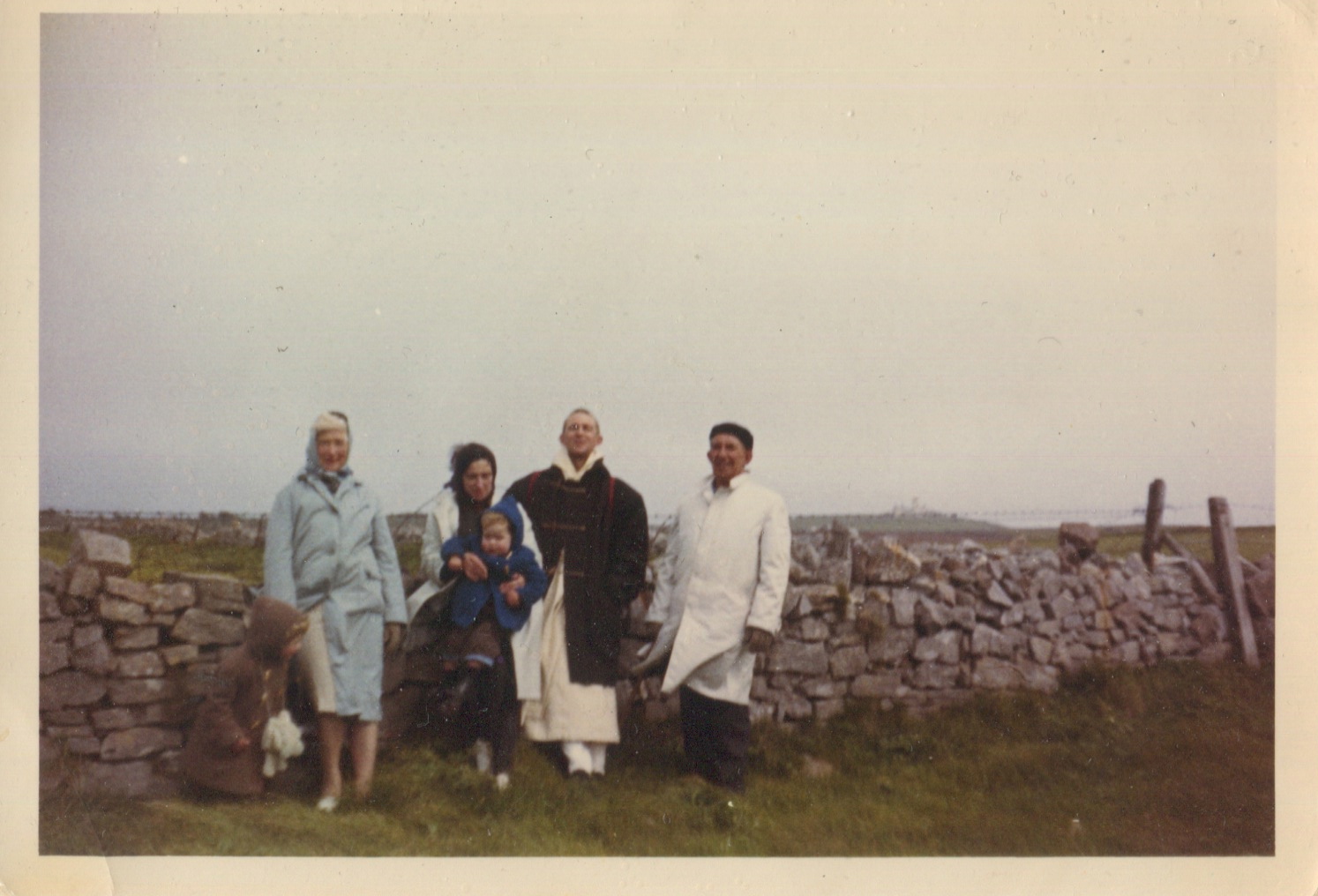
As a concession, he could talk to family once a year, but only when we visited the island, as I did with my mother in the 1960s. I have shadowy memories of our trip and my uncle seemed a mysterious figure with shaved head and billowing white robes. My brother Rod was even more dazzled. “Is Uncle Paddy an island,” he asked on the ferry over. All he knew was that we were going to see Paddy and we were sailing towards an island.


Me (far left, in brown coat) with Mum, brother and grandparents… and Paddy

Now here I am, decades later, returning to Caldey to celebrate my uncle’s 80th birthday – along with his wife, children and six grandchildren! 

So, Paddy eventually turned his back on a life of silent devotion, but thank goodness he did, as he’s been an invaluably articulate influence in countless lives ever since. He did, however, spend a number of years as a monk there and his nearest and dearest thought it would be a fitting way to salute his four score years. 


One of the Abbey's driftwood crosses

We charter a private boat to take us over to the island – his own family, plus a gaggle of nieces, nephews, cousins, and Pad’s remaining siblings –  Michael, 83, from Australia, and Josephine, 86, from the USA. The tide is out so we are transferred to the boat by an amphibian rib we had to clamber aboard, certainly no picnic for my aunt Jo.


Departure from Tenby shore

After a brisk, bumpy crossing we land on a sandy beach that may well be the one described in my uncle’s memoir of his time on Caldey. Try a Little Lowliness (by Patrick Lyons) recalls swimming lessons set up by the Abbot as a safety precaution, which – unhappily for the Abbot – turn out to be an unexpectedly pleasurable interlude in the monks’ austere existence.


Arrival on Caldey island

And very quickly we are passing the front of the monastery and circling round to the guesthouse to meet Brother Titus, the ‘guest master’. He’s the client-facing monk on the island and, as such, is able to converse freely with all and sundry. His sleeves are stylishly folded and his cap sits at a rakish angle. We soon find out that this Dutchman was a F1 driver in his former life. “Too many friends died,” he says, shaking his head. A book of his photography lies on a coffee table. He urges us to make ourselves at home, giving us the run of the lounge and kitchen. He exudes warmth and congeniality. Then he hurries off to prayers.


Paddy revisits his past


Welsh-dragon door knocker at the guesthouse


We explore the island on foot, visiting the old medieval priory, gathering on the cliffs for our family photo call and wandering through the churchyard of the new priory, where Paddy soberly reflects on the graves of all his fellow monks. “If I’d stayed on, I’d be lined up next to them by now,” noting that the frugal diet, sleep deprivation and hard labour of life as a Cistercian was not the recipe for a long life.


We walk on roads that Paddy originally helped to build


Inside the old priory


Window of the soul
We end our visit with 15 magical minutes at the back of the church, listening to the monks as they conduct the service in plainsong. 

Brother Titus gives Paddy and his sister Jo a lift down to the pier to catch our boat back to Tenby. I’m told the former racing driver kept the speed below 30mph.

Paddy and Brother Titus say goodbye

Thursday, 12 February 2015

University challenge


The first London Bulgarian Choir concert of the year is in Cambridge. We’re guests of St Catharine’s College, aka Catz. It’s a great excuse for me and my cousin Veronica, a fellow singer, to bunk off and hit the town early to submerge ourselves in collegiate culture before we’re due at the chapel for the pre-concert run-through.

Catz call
Kettle’s Yard is our first stop, the home of Jim and Helen Ede. Jim had been a curator at the Tate Gallery in the 1920s and 1930s, befriending the likes of Henry Moore and Ben Nicholson and acquiring works by his mates and other artists. The Edes moved to Cambridge in 1956 and transformed four cottages into Kettle’s Yard, as Jim said at the time, ‘a place where people would find a home and a welcome, a refuge of peace and order, of the visual arts and music… in which stray objects, stones glass, pictures, sculpture are arranged in light and space’. The couple later donated the place to the University of Cambridge, and it has been left as it was, the centre of a programme of music and exhibitions. 

The Edes’ home for cherished art and furnishings 

There’s an overwhelming sense of peace and calm, and, walking around, I want to copy every exquisite little detail in my own home. Round grey stones arranged in swirls, awkward alcoves turned into intimate dining spaces, coloured glass pieces catching the setting sun. Sculptures are perfectly positioned and paintings hang in beautiful groups, a Miro here, a Moore there. People are scattered about the place reading art books and catalogues. 

No stone left unturned

Crystal palace

Casually placed canvas


We drag ourselves away to take a look at an exhibition in the adjoining gallery. It turns out to be equally contemplative, on the landscape artist and poet Ian Hamilton Finlay. He and his wife designed a garden in front of their home in the Scottish Borders, placing sculptures and stones carved with poems among the plants and trees. They called it Little Sparta and the show features images and a film of the garden.

Stone work by Finlay

Next, we move on to Peterhouse, my father Eric’s old college. He was a fellow there in the late 1940s to early 1950s, and honed his rock climbing skills on the perimeter walls when he failed to make it back before the gate was locked.

Peterhouse sunset

I stop for a Chelsea bun at Dad’s favourite café, Fitzbillies, just along the road. This place is a Cambridge institution and, as such, was stuffed to the gills with trippers and tourists.

Daddy cool

The concert is an atmospheric one. There are dozens of music students in the audience, which is a little daunting for us, but everyone seems transported. Little do they know that we haven’t sung together since Christmas, as our leader has been on maternity leave. Luckily we’re the only ones aware of the bum notes and at the drinks after the concert, people approach us with faces alive and eyes shining. I think we got away with it…